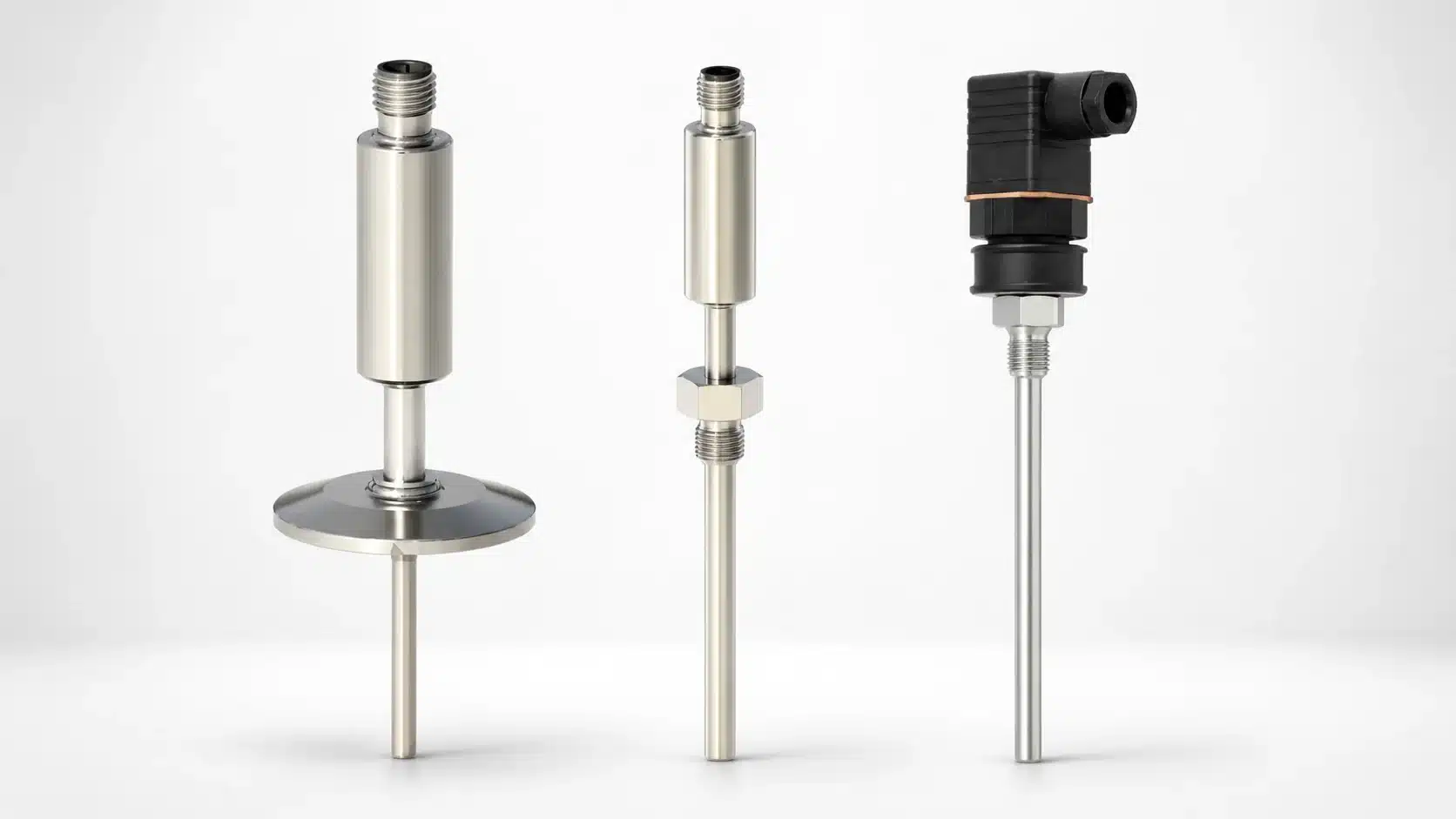
A Pt100 or Pt1000 element outputs a small resistance signal a control system can’t read directly, so most installations add a separate transmitter — in the connection head or on a DIN rail — to convert it. Kjaerulf Pedersen a/s builds the transmitter into the sensor itself: the electronics sit in the sensor’s own compact housing and output a standard 4–20 mA signal, with no separate transmitter or connection head — in industrial, hygienic and valve-plug versions.
Why put the transmitter in the sensor
A separate transmitter usually takes one of two forms: a round module fitted inside the sensor’s connection head, or a DIN-rail unit in the control cabinet. Both need space — a full-size head or cabinet room — and add a component to specify, wire and maintain.
KP builds the transmitter into the sensor’s own housing, behind the connector. The output is a standard 4–20 mA current loop, which is immune to cable-length voltage drop and electrical noise and reads straight into any PLC or SCADA input — one part instead of two or three, and a fit where a full connection head won’t go.
One design, three versions
The same integrated-transmitter design comes in three versions — industrial, hygienic and valve-plug — each configurable across process connections, immersion lengths and sensor elements:

BP1-T
Compact industrial build with an M12 connector. Pt100 or Pt1000, and a wide choice of process connections, immersion lengths and cable options.
View BP1-T →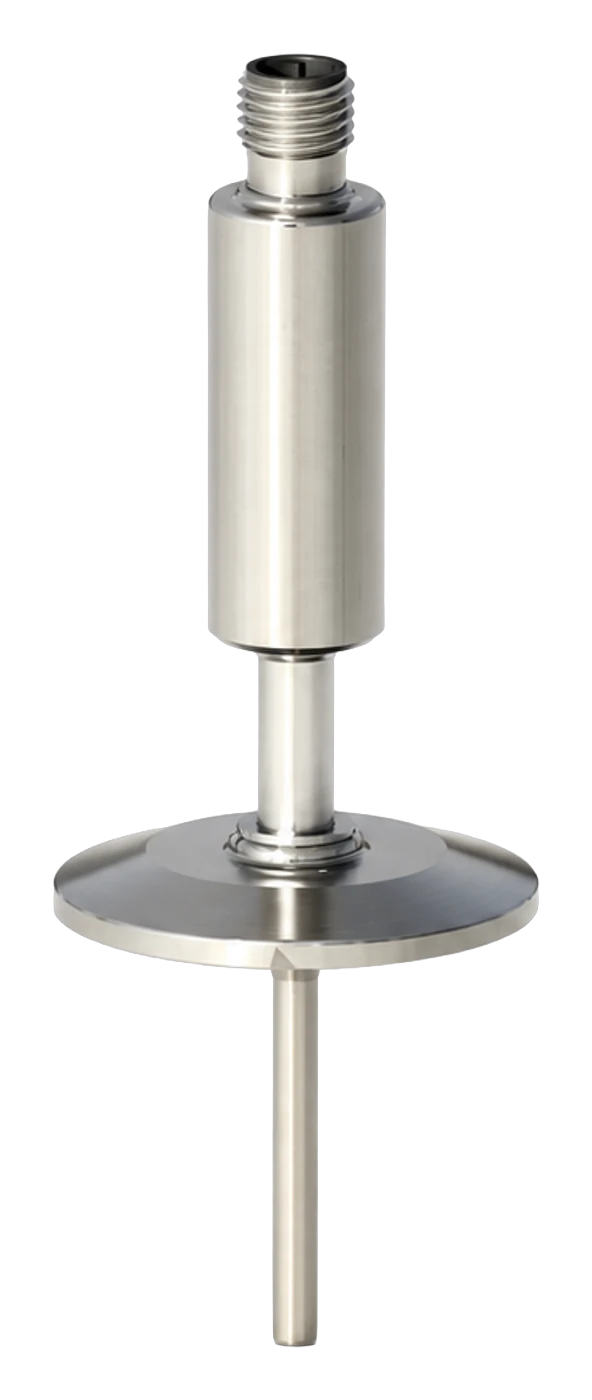
RT-BP1-T-C
The sanitary version of the BP1: electro-polished 316L, CIP/SIP-ready, with a wide range of hygienic process connections.
View RT-BP1-T-C →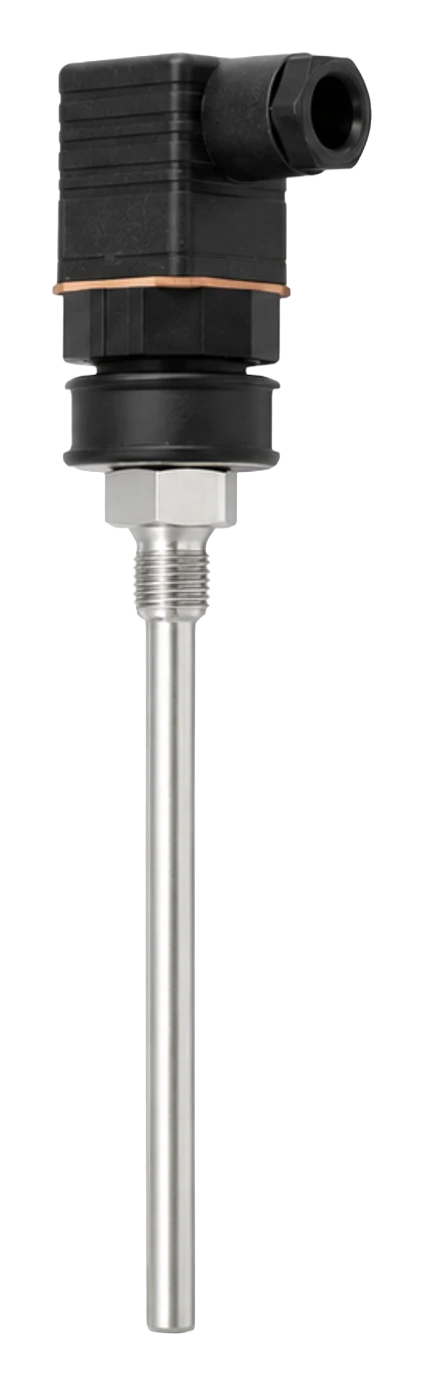
BP2-T
Valve-plug connection (DIN EN 175301-803-A, IP65) for quick plug connect and disconnect. Pt100 or Pt1000, configurable connections and immersion lengths.
View BP2-T →Where it fits
The integrated-transmitter sensors are used across general industry and process automation — power and energy, HVAC and refrigeration, chemical processing, and oil and gas. The RT-BP1-T-C is the sanitary version for pharmaceutical, dairy, food and beverage, and biotech lines, with an electro-polished 316L body and CIP/SIP compatibility.
What engineers ask most
What is a temperature sensor with an integrated transmitter?
A temperature sensor that houses the transmitter electronics inside its own compact body, converting the Pt100 or Pt1000 signal into a standard 4–20 mA output at the sensor itself. No separate transmitter, signal conditioner or connection head is needed.
How is it different from a head-mounted transmitter?
A head-mounted transmitter is a separate round module fitted inside a sensor’s connection head, which takes space and adds a component. In an integrated sensor the transmitter is built into the compact housing itself — so it fits where a full connection head won’t, with fewer parts.
Why a 4–20 mA output?
A 4–20 mA current loop is immune to the voltage drop and electrical noise that affect a raw resistance signal over long cable runs, and it is the standard input for PLC and SCADA systems — robust and simple to integrate.
Is there a hygienic version for CIP/SIP?
Yes. The RT-BP1-T-C has an electro-polished 316L (EN 1.4404) body with a surface finish below 0.5 µm, a range of hygienic process connections, and full Clean-in-Place / Steam-in-Place compatibility for pharmaceutical, dairy and food & beverage lines.
Need a temperature sensor with a ready 4–20 mA output?
Tell us your process connection, temperature range, electrical connection and any hygienic or documentation requirements, and we’ll match the right integrated-transmitter sensor.
Contact our expertsEmail us