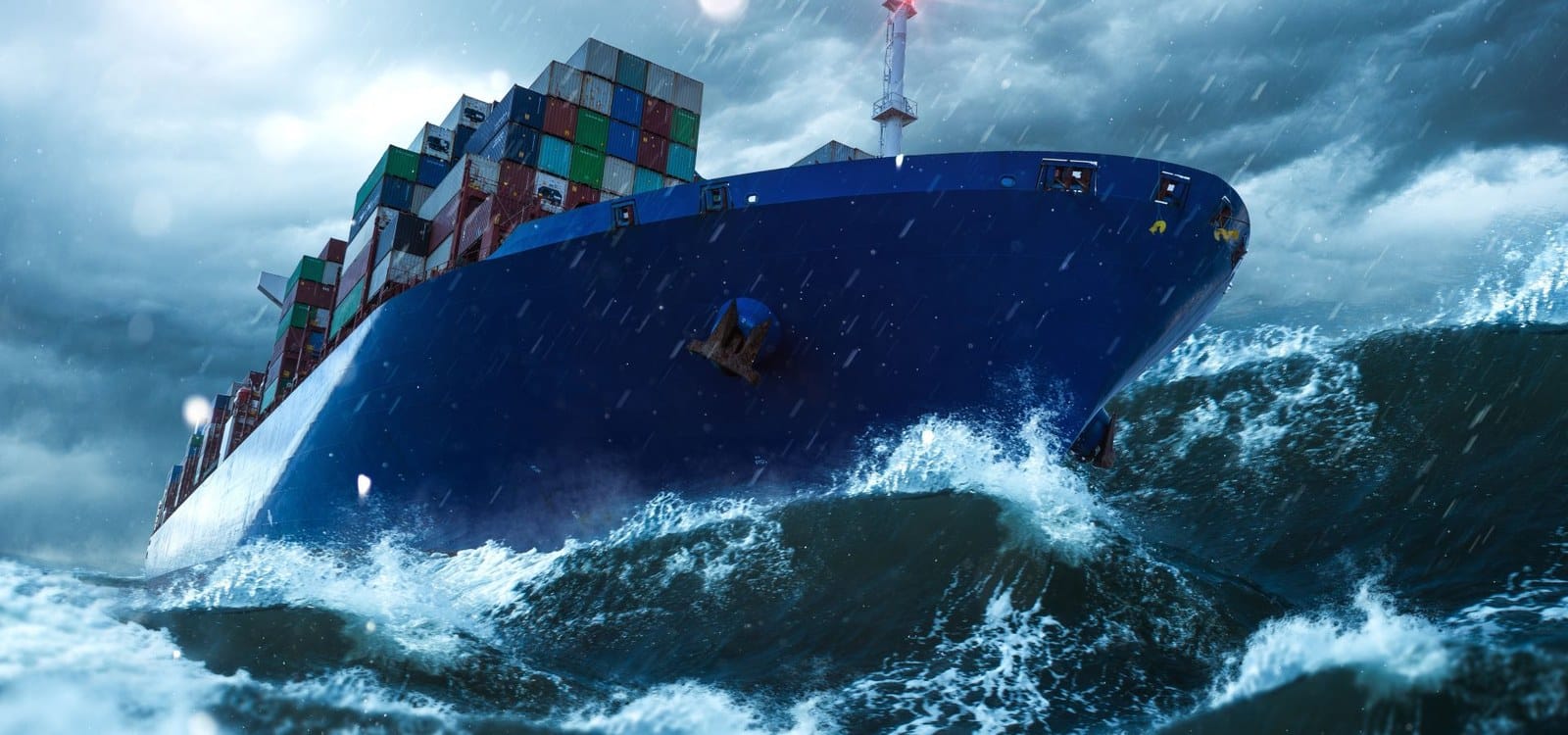
Container loss at sea has averaged around 1,400 boxes per year since 2008, and the dangerous roll phenomena that cause it — parametric roll, synchronous roll, resonance roll — remain among the most difficult conditions for container vessel operators to anticipate. Real-time motion monitoring closes the gap between recognising risk and acting on it, helping crews avoid the conditions that lead to cargo loss before they develop.
Why ship motion drives container loss
Container loss at sea is not a constant risk. It is a tail-risk that materialises sharply when vessel motion combines with specific weather and loading conditions. Since 2008, container vessels have lost an average of 1,400 boxes per year overboard. In a single event in late 2021, around 3,500 containers vanished in the Pacific in storm conditions that exposed how rapidly motion-induced roll can escalate beyond the limits of conventional lashing systems.
The root cause is a small set of well-documented roll phenomena: parametric roll, synchronous roll and resonance roll. Each develops when specific combinations of wave period, wave direction and the vessel’s own natural roll period align. Once they begin, they can amplify within minutes, pushing roll angles past the values that container stowage and lashing equipment are certified to handle.
For container vessel operators, the operational challenge is anticipation. By the time roll reaches critical angles, conditions have already developed past the point where speed reduction or heading change can fully contain them. The window for effective action sits earlier, when motion patterns first signal that a dangerous roll regime may be building. That early warning is what real-time motion data provides.
“Loss is tied to dangerous roll phenomena at sea — parametric, synchronous and resonance roll are key risks.”
From the Kjaerulf Pedersen a/s container vessel case study
What the MDU measures and how it operates onboard
The Motion Detecting Unit is a self-contained onboard system that captures vessel motion in real time, including pitch, roll, dynamic trim and motion intensity. The unit is built on a hybrid sensor platform with accelerometer, gyroscope and magnetometer, providing the inertial data required to characterise vessel behaviour at the resolution operational decisions demand. Updates run at 100 measurements per second, with both live and historical motion data available to the bridge.
The MDU is designed for autonomous operation. Data processing is handled internally by the unit, and the system supports configurable visual alarms tied to motion thresholds set for the specific vessel and loading condition. It is built for continuous 24/7 operation and integrates with existing onboard systems, so motion data can be combined with other operational inputs — vessel speed, fuel flow, draft, depth — rather than treated as a parallel stream.
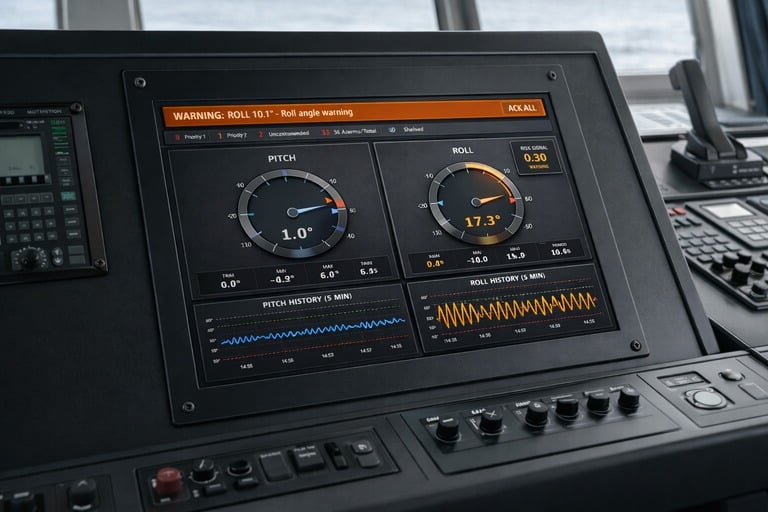
From motion data to operational action
Live motion data only matters if it changes operational decisions. The MDU was developed in collaboration with one of the world’s largest shipping companies specifically to support the kind of action that prevents container loss — providing early warnings of situations that may lead to parametric roll and similar risk events, and enabling proactive responses before those situations develop into damage.
In practice, motion data supports a few specific decision patterns on container vessels:
- Speed and heading adjustment when forecast wave conditions match the vessel’s roll-natural period
- Route deviation around weather systems where motion data shows risk patterns developing
- Real-time decision support during severe conditions when roll thresholds are being approached
- Continuous motion documentation that supports post-voyage analysis and operational learning
Beyond container safety, the same motion data supports broader operational efficiency. By informing trim, route and speed decisions, MDU data helps reduce fuel consumption, emissions and mechanical wear — and contributes directly to compliance with current and upcoming IMO regulations on energy efficiency, including the Carbon Intensity Indicator (CII) and the Energy Efficiency Existing Ship Index (EEXI). Motion intelligence and emissions compliance are increasingly the same conversation.
What operators ask most
What is parametric roll, and why is it dangerous for container ships?
Parametric roll occurs when specific combinations of wave period and direction align with the vessel’s natural roll period, causing pitch and roll to couple together and amplify rapidly. On container vessels, the roll angles that develop can exceed the limits container lashing systems are designed to handle, leading to cargo damage and loss overboard.
How does ship motion monitoring help prevent container loss?
Real-time motion monitoring captures the pitch, roll and motion patterns that indicate dangerous roll regimes are developing, typically before crew can perceive them directly. The MDU provides early warnings that allow operators to adjust speed, heading or route while there is still time to prevent conditions from escalating to container loss.
What does the MDU measure?
The MDU captures vessel motion at 100 measurements per second, including pitch, roll, dynamic trim and motion intensity. It is built on a hybrid sensor platform with accelerometer, gyroscope and magnetometer, and provides both live and historical motion data on the bridge with configurable visual alarms.
How is the MDU installed and integrated?
The MDU is designed for ship-crew installation as a self-contained unit. It operates autonomously without third-party dependencies and supports integration with existing onboard systems, allowing motion data to be combined with vessel speed, fuel flow, draft and depth for operational analysis.
How does the MDU support compliance with IMO regulations?
The MDU supports compliance with current and upcoming IMO regulations on energy efficiency and emissions — including the Carbon Intensity Indicator (CII) and the Energy Efficiency Existing Ship Index (EEXI) — by providing the motion data needed to optimise trim, routing and fuel consumption. From January 2026, new container vessels of 3,000gt and above must also carry type-approved electronic inclinometers under SOLAS Reg. V/19.2.12; the MDU complements those basic carriage requirements with broader motion analytics for operational decision-making.
Discuss MDU for your container fleet
For technical specifications, integration questions or fleet-scale deployment, the marine solutions team at Kjaerulf Pedersen a/s is the right starting point.