
In a water distribution network, the most damaging events are often the ones you can’t see. Pressure surges — water hammer — and developing leaks build and dissipate in seconds, and conventional control systems give limited feedback on either. But these hydraulic events leave a clear signature in vibration. The KPV200 vibration sensor captures that signature at the pump and turns raw movement into FFT data on the sensor itself, so operators can detect water hammer, leaks and pump faults as they happen.
What water hammer and leaks look like in vibration data
Water hammer is a pressure transient. When flow changes abruptly — a valve closes, a pump starts or trips — a pressure wave travels through the network, reflects off boundaries and stresses pipes, joints and fittings. Because it develops and passes in seconds, periodic pressure logging often misses it, and what remains is the cumulative wear.
Leaks behave differently but are just as hard to see directly. They shift flow and produce their own characteristic patterns. Both phenomena show up in vibration. Measured at the pump, surge events, their reflections and leak-related anomalies become visible in the frequency data — which is what makes vibration a practical way to monitor a network’s hydraulic behaviour rather than just its steady-state pressure.
“Sensor data combined enables harmonic analysis and better preparedness.”
From the Kjaerulf Pedersen a/s water treatment case study
What the KPV200 measures and how it connects
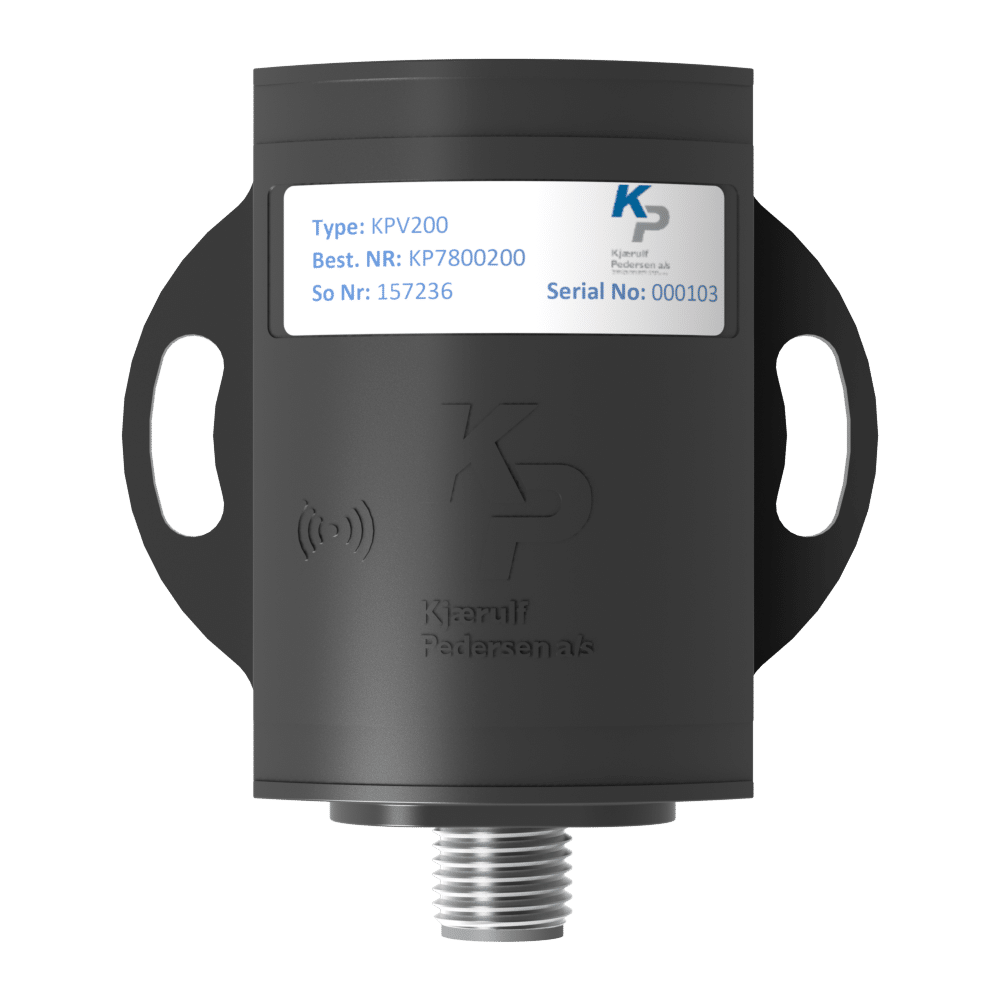
The KPV200 is an intelligent vibration sensor built around a hybrid accelerometer and an onboard DSP. It measures vibration in three axes — X, Y and Z — across selectable frequency bands up to 1600 Hz, and it does not simply stream raw signal. It computes a 128-bin FFT on the sensor and outputs that, so the analysis happens at the source.
Output is RS485 Modbus over an M12 connector, with a built-in configurable alarm system, a selectable measurement range, and a rugged, vibration-resistant housing rated from −40 to +85 °C. It is plug-and-play and EMC tested. Because the FFT runs on the sensor, data can be filtered before anything is uploaded — so the KPV200 works without cloud dependency, which matters where bandwidth, latency or data ownership are concerns.
From vibration signatures to operational action
Vibration data is only useful if it changes decisions. At the water treatment plant, the KPV200 supports three: detecting water hammer and mapping surge reflections, so pump control can be tuned to reduce damaging pressure spikes; identifying leak-related anomalies by merging sensor data with pump and network data; and monitoring pump condition itself — bearing wear, imbalance and mechanical faults — for predictive maintenance.
Combined, the data supports harmonic analysis across the system, and learning curves help define which signal patterns are normal and which warrant attention. One sensor, working at the edge, covers hydraulic events, leaks and machine health at once.
What operators ask most
Can vibration sensors detect water hammer?
Yes. Water hammer is a pressure transient that produces a distinct vibration signature in pipework and at pumps. The KPV200 measures vibration up to 1600 Hz and outputs FFT data, which lets operators identify surge events and their reflections — including fast transients that periodic pressure logging tends to miss.
How can vibration data reveal leaks?
Leaks change flow behaviour and generate characteristic vibration patterns. Combined with pump and network data, the KPV200’s FFT output helps identify leak-related anomalies and supports faster, more targeted investigation.
What does the KPV200 measure, and how does it connect?
It measures three-axis (X, Y, Z) vibration across selectable bands up to 1600 Hz, output as a 128-bin FFT array over RS485 Modbus (M12). It includes a configurable alarm system and is designed for plug-and-play installation in harsh industrial and utility environments.
Does the KPV200 need a cloud connection?
No. It performs FFT analysis on the sensor and can filter data before upload, so it runs without cloud dependency. That keeps bandwidth low and data ownership local.
Can the KPV200 be used for pump condition monitoring and predictive maintenance?
Yes. FFT vibration analysis is well suited to detecting bearing wear, imbalance and mechanical anomalies, so the same sensor that flags hydraulic events also supports predictive maintenance on the pumps themselves.
Discuss the KPV200 for your water network
For technical specifications, integration questions or deployment across multiple sites, the team at Kjaerulf Pedersen a/s is the right starting point.