Product · Vibration Sensors
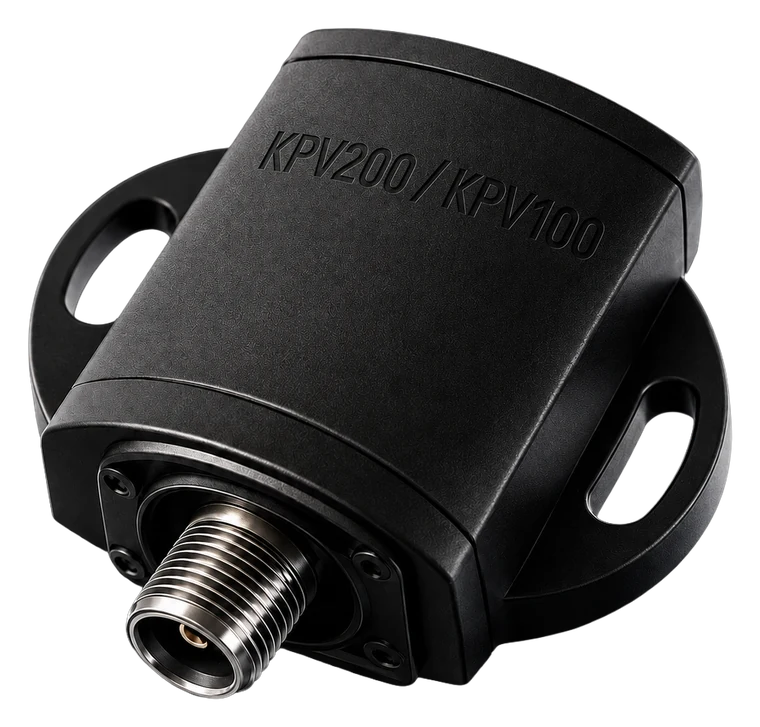
Vibration Sensor KPV200 / KPV100
Find your local partner on the distributor map.
Application
The KPV200 / KPV100 is an intelligent triaxial vibration sensor that computes a 128-bin FFT spectrum in the sensor itself and delivers it as ready-to-use data — over RS485 Modbus RTU (KPV200) or industrial Bluetooth (KPV100). It is built for condition monitoring and predictive maintenance: a self-learned baseline alarm runs in the sensor, and data stays in your own system.
Vibration is one of the earliest warnings
Vibration is one of the earliest indicators of mechanical wear. Where a temperature alarm may not trigger until a fault is roughly 40% progressed, and audible symptoms until around 60%, vibration monitoring can detect emerging faults at approximately 10% development. This gives maintenance teams enough lead time to plan repairs before real damage sets in — reducing downtime, limiting wear, and eliminating costly surprises.
The spectrum is computed in the sensor
An accelerometer and an onboard DSP turn raw vibration into a 128-bin FFT spectrum inside the sensor, so what leaves the sensor is analysis-ready frequency data rather than a raw signal. The measuring range is selectable from ±2 g to ±16 g, and six sampling rates set the frequency span — from 1–50 Hz at the finest resolution (0.39 Hz per bin) up to 0–1600 Hz — measured in three axes, X, Y and Z.
An alarm baseline the sensor learns on the machine
Set the sensor in learning mode for a few days and it records the normal vibration signature of the exact machine it sits on. That learned curve becomes the alarm baseline: when any frequency bin exceeds the baseline plus a configurable offset — filtered by a configurable delay — the sensor raises the alarm itself. The curve is stored in the sensor and survives power cycles.
Speaks Modbus with the systems already in place
The KPV200 connects directly to a PLC, SCADA system or supervision computer over RS485 Modbus RTU, with the live spectrum, the learned curves and the alarm flag all available as documented registers. Several sensors share one bus through the 1–247 address range, so multi-point monitoring runs on a single cable pair. The KPV100 is the same sensor with industrial Bluetooth communication and PNP and NPN alarm outputs in the M12 connector.
From pumps and conveyors to ships
Typical applications include marine and aquaculture installations, pumps, motors, compressors, fans, gearboxes, and rotating equipment across industrial, HVAC, refrigeration, and oil & gas environments — anywhere early fault detection turns maintenance from a cost into a strategic advantage. In water networks, the FFT output is used to detect pressure surges and support leak detection at the pumps. Together with the KPM100 motion sensor on the same Modbus bus, one cable pair carries both vibration and motion.
Configured from a PC — or from your own platform
The KP Windows software shows the live spectrum, controls the learning curve and sets alarm offset and delay. It can operate stand-alone or as part of a larger installation, and is configured either through the optional KP software or directly within your own platform via the documented Modbus registers.
Properties
| Measuring principle | Accelerometer element and onboard DSP; all FFT analysis computed in the sensor |
|---|---|
| Output | 128-bin FFT spectrum; learned baseline curve, alarm curve and alarm flag |
| Axes | Three axes: X, Y and Z; FFT computed per selected axis |
| Vibration range | ±2, ±4, ±8 or ±16 g, selectable |
| Frequency ranges | 1–50 Hz, 0–100 Hz, 0–200 Hz, 0–400 Hz, 0–800 Hz and 0–1600 Hz (sampling 100–3200 Hz); resolution from 0.39 Hz per bin |
| Alarm | Self-learned baseline (learning curve) with configurable offset and delay, evaluated in the sensor; settings and curves stored in the sensor |
| Communication, KPV200 | RS485 Modbus RTU; function codes FC3, FC4 and FC16; documented register map |
| Communication, KPV100 | Industrial Bluetooth; PNP and NPN alarm outputs in the connector |
| Bus | Address range 1–247; several sensors on one RS485 bus |
| Electrical connection | M12; others on request |
| Supply | 10–28 VDC |
| Temperature | Ambient −40 to +85 °C |
| EMC | EN 61000-6-3 (emission), EN 61000-6-2 (immunity) |
| Software | Optional KP Windows software for live spectrum, learning curve and alarms; or direct integration via the documented Modbus registers |