Kjaerulf Pedersen a/s · Condition Monitoring
Condition Monitoring
One monitoring system, built industry by industry — vibration, motion, temperature and dewpoint data that turn maintenance into a plan. Intelligent, plug and play sensors from Kjaerulf Pedersen a/s.
What is condition monitoring?
Condition monitoring is the continuous measurement of vibration, temperature, motion and humidity on machines and structures, used to detect developing faults early — so maintenance can be planned before a breakdown occurs.
Permanently installed sensors collect data around the clock and watch for change. A shift in vibration level, bearing temperature or motion pattern is often the first sign of early-stage deterioration. The measurement itself is non-intrusive, so condition monitoring can be applied to new machines and existing installations alike.
Condition monitoring is the data foundation of predictive maintenance: service is planned when the measurements show it is needed. The result is fewer unplanned stops, longer machine life, better use of spare parts and maintenance hours — and documentation of how every monitored asset actually behaves.
One system, four signals
A fault announces itself three times
Vibration hears it first
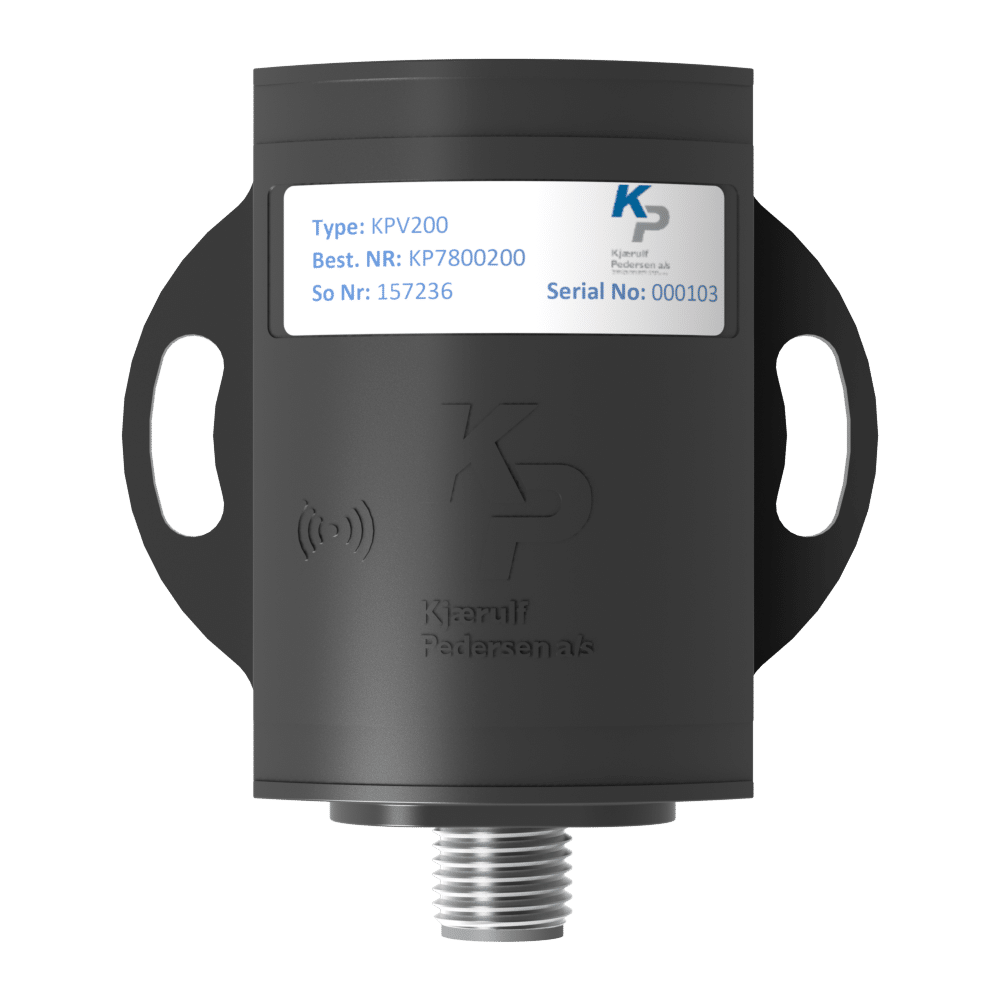
Vibration monitoring can detect an emerging fault at approximately 10 % development, measured with the KPV200, which converts raw vibration to FFT data inside the sensor.
Temperature reacts
A temperature alarm may not trigger until a fault is roughly 40 % progressed.
You can hear it
Audible symptoms appear at around 60 % — with real damage already done and repair costs climbing.
The four signals
Every application reads its own combination
Vibration
The earliest warning on rotating machinery — FFT data straight from the KPV200.
Motion
Roll, pitch, yaw and acceleration from the KPM100 — where structures and vessels move.
Temperature
Bearings, stern tubes and whole engine rooms — up to eight points at once with the TempMux-8.
Dewpoint
The KPH300 guards cabinets, AHUs and nacelles against condensation.
Vibration is the earliest warning on rotating machinery — FFT data straight from the KPV200. Motion — roll, pitch, yaw and acceleration from the KPM100 — carries the story where structures and vessels move. Temperature watches bearings, stern tubes and whole engine rooms, drawing on the same program that carries our temperature sensors worldwide — from single measuring points to eight at once with the TempMux-8. And dewpoint from the KPH300 guards cabinets, AHUs and nacelles against condensation.
Which signals matter — and where — is an industry question. That is why condition monitoring at Kjaerulf Pedersen a/s is built industry by industry.
Condition monitoring for your industry
Every industry
What to monitor, which data you get, and what it changes in daily operation.
Software and integration
From sensor to plan
Measure
Vibration, motion, temperature and dewpoint — permanently installed, non-intrusive.
Process in the sensor
The KPV200 delivers analysis-ready FFT data; alarm thresholds are configured per application.
Deliver over Modbus
Modbus RTU (RS485) straight into PLC or SCADA — stand-alone or part of a larger installation.
Plan
The sensor raises the flag the moment behaviour changes — and maintenance becomes a plan.
Every KP condition monitoring sensor communicates over Modbus RTU (RS485) — a widespread, well-documented industrial protocol — and integrates directly into a PLC or SCADA system, stand-alone or as part of a larger installation. KP’s own software handles configuration and alarm setup, and the KPV200 can also be configured over Bluetooth.
Condition monitoring
Frequently asked questions
What is condition monitoring?
Condition monitoring is the continuous measurement of parameters such as vibration, temperature, motion and humidity on machines and structures. The data is used to detect developing faults early, so maintenance can be planned before a breakdown occurs. Sensors are permanently installed, and the measurement is non-intrusive — it works on new machines and existing installations alike.
What is the difference between condition monitoring and predictive maintenance?
Condition monitoring is the measuring discipline: collecting vibration, temperature, motion and humidity data from machines and structures. Predictive maintenance is the maintenance strategy that uses this data to plan service before faults become failures. Condition monitoring delivers the data; predictive maintenance acts on it.
How early can vibration monitoring detect a developing fault?
Vibration monitoring can detect an emerging mechanical fault at approximately 10 % of its development. By comparison, a temperature alarm typically reacts when the fault is roughly 40 % progressed, and audible symptoms appear at around 60 %. This is why vibration is regarded as the earliest practical warning of mechanical wear in rotating machinery.
Which parameters are measured in condition monitoring?
Four signals cover most applications: vibration (the earliest warning on rotating machinery), motion (roll, pitch, yaw and acceleration on structures and vessels), temperature (bearings, stern tubes and multipoint measurement across engine rooms) and humidity/dewpoint (condensation control in cabinets and HVAC systems). Kjaerulf Pedersen a/s offers intelligent plug and play sensors for all four.
Do KP condition monitoring sensors work with an existing PLC or SCADA system?
Yes. The sensors communicate over Modbus RTU (RS485) and integrate directly into existing PLC and SCADA systems. They can also run stand-alone. Configuration and alarm setup are handled with KP’s own software, and the KPV200 can additionally be configured over Bluetooth.
Clear and timely warnings that stop costly failures. Maintenance you can plan. Production you can rely on. Condition monitoring from Kjaerulf Pedersen a/s — intelligent plug and play sensors that fit into the monitoring systems you already run.