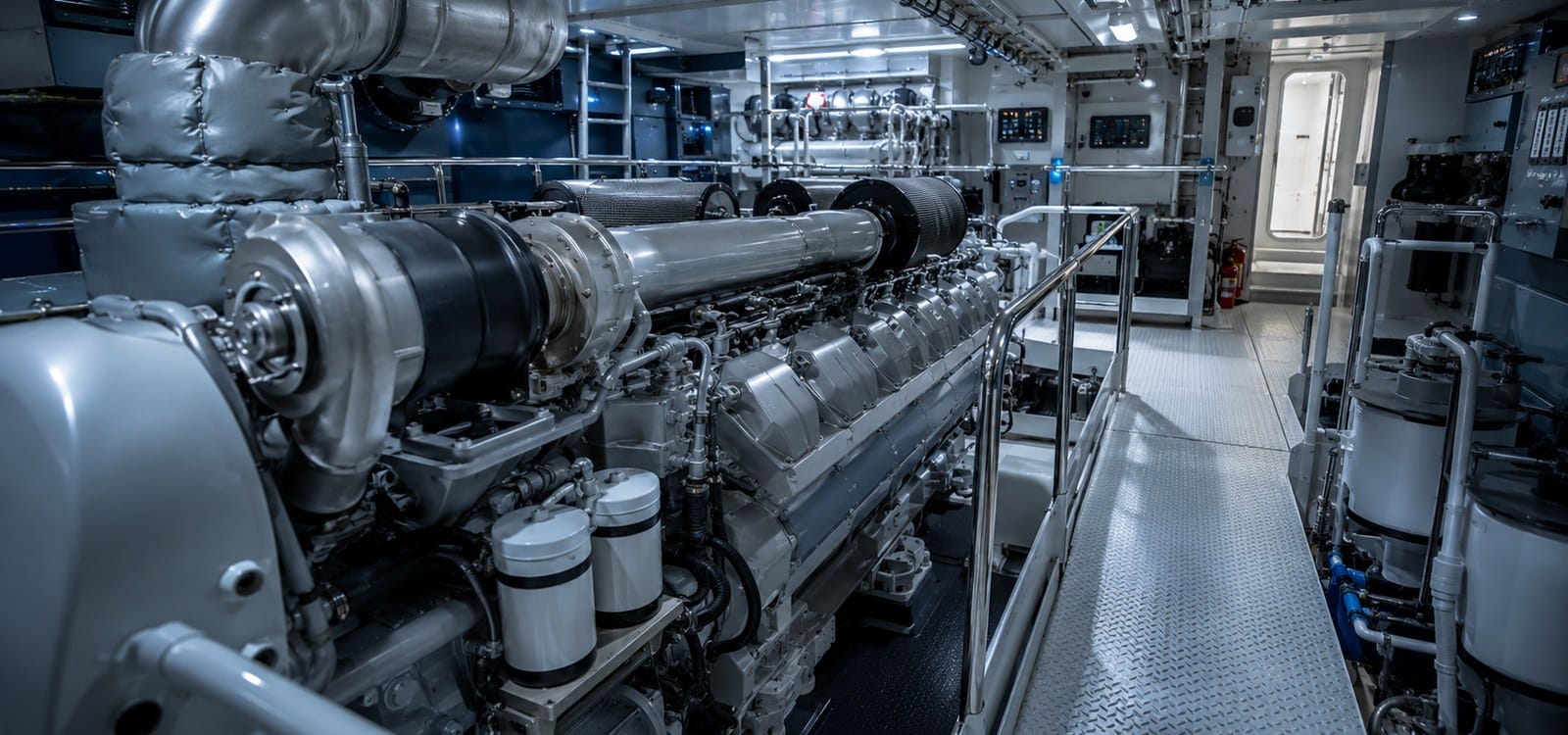
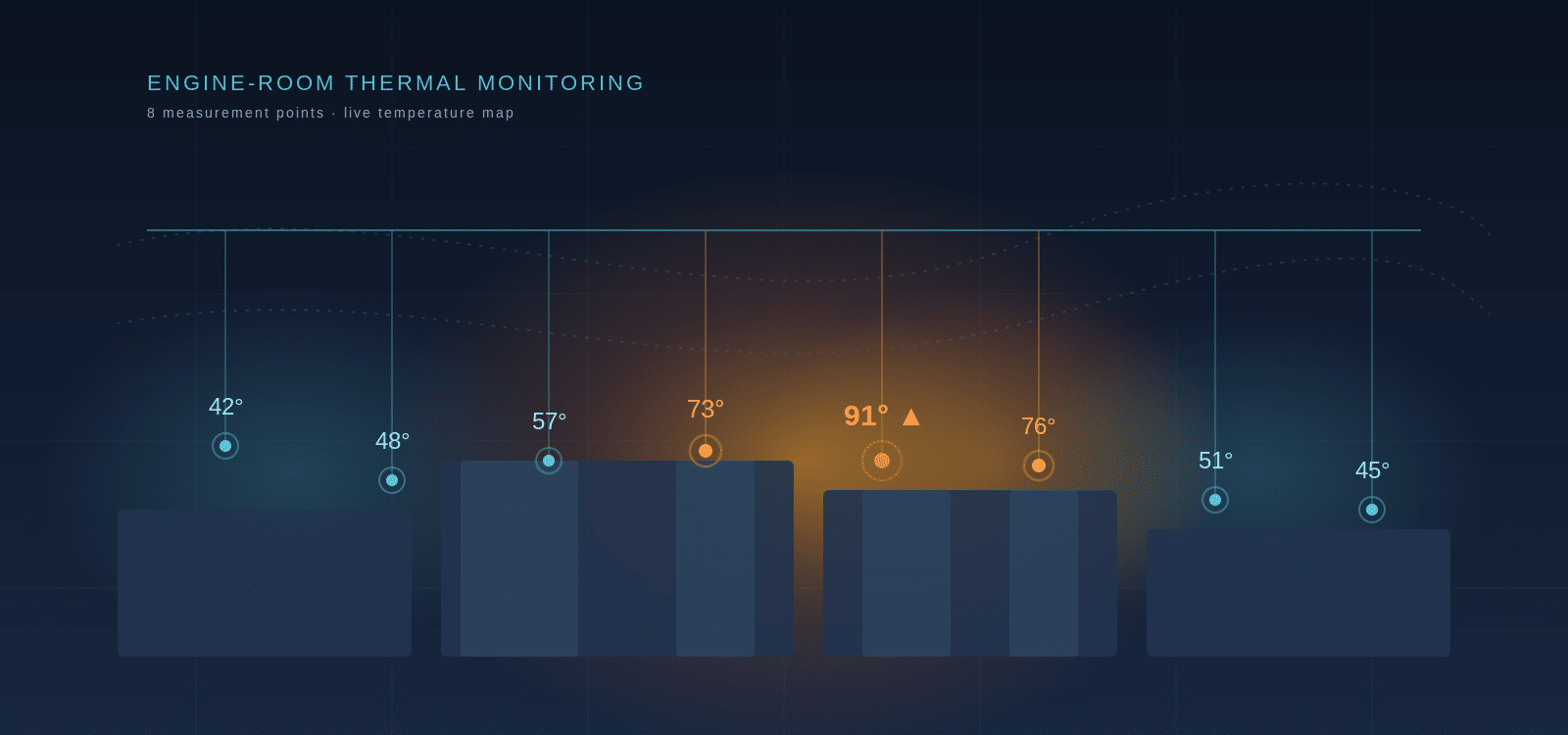
An engine room is one of the hottest, busiest spaces on a vessel, and the first sign of trouble — a blocked vent, a component starting to run warm, an airflow path quietly losing its draught — usually shows up as temperature, in one specific spot. A single sensor somewhere else misses it. The TempMux-8 watches up to eight points at once, turning the engine room into a live temperature map so operators can see a hot spot forming before it becomes a fault.
Why one temperature reading isn’t enough
Engine rooms in marine and industrial settings are complex, high-heat environments, and small temperature anomalies are often the earliest sign of a developing mechanical issue. The difficulty is location. A hot spot from a blocked vent, a struggling pump or a disrupted airflow path appears in one place — and a single sensor mounted somewhere else simply won’t see it.
What changes the picture is coverage: temperature measured at several points, continuously, so a rising local reading stands out against the rest. It is also how airflow problems become visible. When one zone runs hotter than its neighbours, that contrast points to a blocked vent or an overheating component long before a conventional alarm would trip.
“Even small temperature anomalies can indicate the onset of mechanical issues.”
From the Kjaerulf Pedersen a/s engine room case study
What the TempMux-8 measures and how it connects
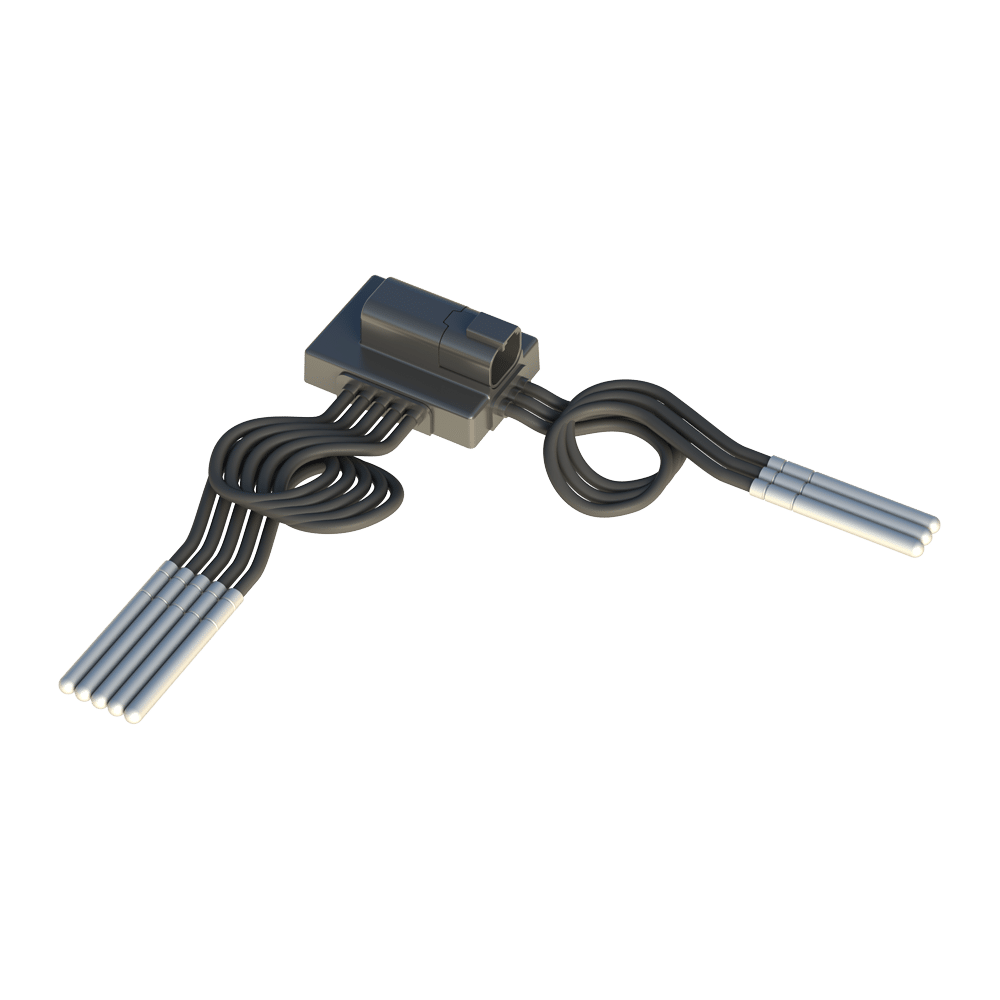
The TempMux-8 is a multipoint temperature sensor built for engine room conditions. It supports up to eight PT1000 sensor inputs, so a single unit covers eight locations across the compartment, and it communicates over Modbus RTU (RS485) for straightforward integration with the control and monitoring systems already onboard.
The housing is compact and rugged, designed for the heat, vibration and tight spaces of an engine room. Placed with intent — across vents, around the main engine, near the components that tend to run hot — the eight inputs build a real-time temperature map of the space rather than a single number.
From temperature map to early warning
A temperature map only matters if it changes what happens next. By comparing the eight readings continuously, the TempMux-8 makes the patterns that count easy to spot: a single point climbing while the others hold steady — a localised fault or blockage — or a whole zone drifting upward, which signals a cooling or airflow problem.
That early signal is what lets crew act before a hot spot turns into damage: check a vent, ease a load, or schedule maintenance on the component that’s running warm. The modular array makes it easy to monitor different locations within the engine compartment, giving a comprehensive, real-time temperature picture and supporting preventive maintenance rather than reactive repair.
What operators ask most
Why use a multipoint temperature sensor in an engine room?
A single sensor only sees its own location, but engine-room problems — blocked vents, overheating components — show up as a localised temperature rise. Measuring at several points means a developing hot spot stands out against the rest, before it becomes a fault.
How can temperature data reveal airflow problems?
Airflow issues show up as heat. When one zone runs hotter than its neighbours, it points to a blocked vent, poor circulation or an overheating component. A multipoint temperature map makes that contrast visible, where a single reading would miss it.
What does the TempMux-8 measure, and how does it connect?
It supports up to eight PT1000 temperature inputs and communicates over Modbus RTU (RS485), for integration with existing onboard control and monitoring systems. The housing is compact and rugged for engine room conditions.
Can the TempMux-8 support predictive maintenance?
Yes. Continuous multipoint temperature data helps identify components running warm or zones heating up, so maintenance can be planned around early signals rather than waiting for a failure.
Where can the TempMux-8 be used?
It is built for the high-heat, high-vibration conditions of marine and industrial engine rooms, and suits any application where temperature needs to be monitored at several points and integrated over Modbus.
Discuss the TempMux-8 for your engine room
For technical specifications, integration questions or a multi-point setup for your engine room, the team at Kjaerulf Pedersen a/s is the right starting point.