Product ·

Temperature Sensor – Type A (RT-A/TC-A)

Find your local partner on the distributor map.
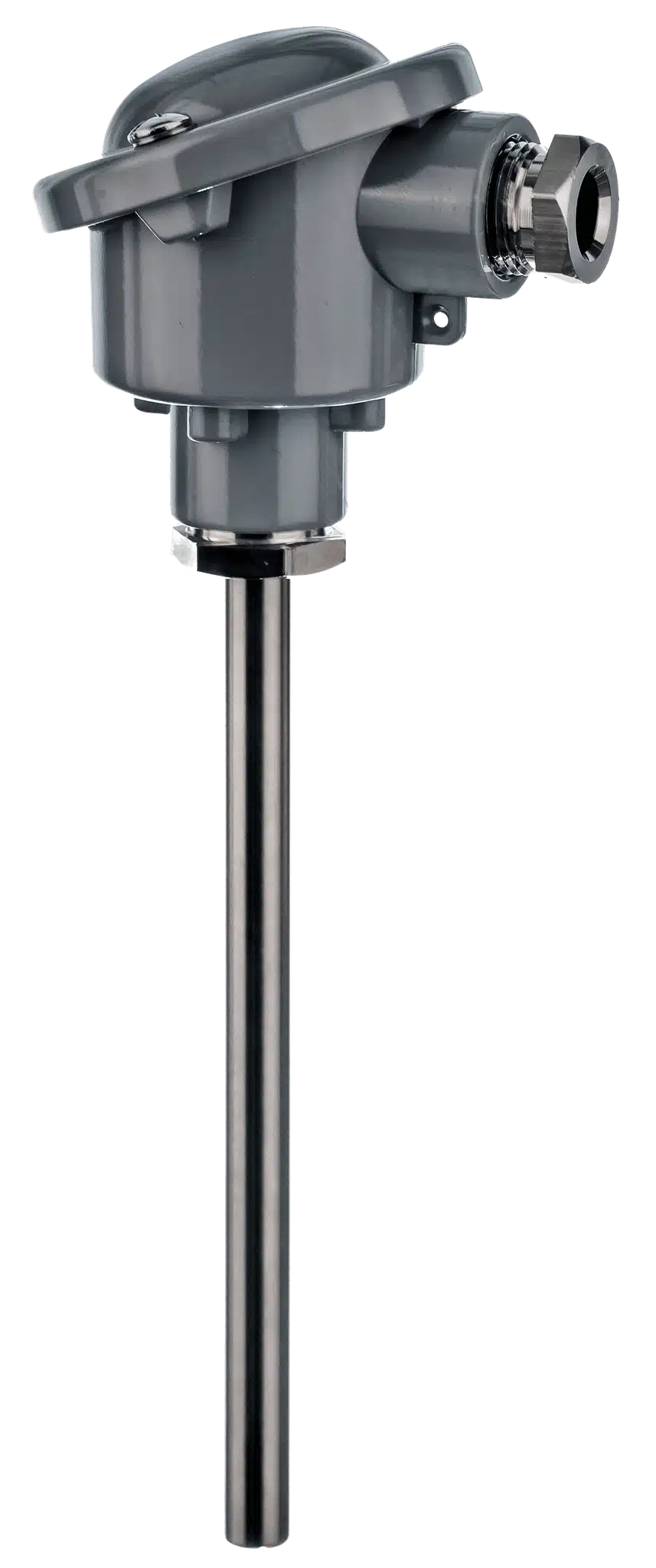
Type A temperature sensor with an interchangeable measuring insert and adjustable immersion depth
Type A – RT-A resistance thermometer or TC-A thermocouple, both with an interchangeable measuring insert

Application

Correct positioning of the measuring point is essential for accurate temperature measurement. Type A allows the immersion depth to be adjusted during installation. If the measuring point is positioned too close to the pipe wall, heat conducted through the protection tube can influence the measured temperature. The protection tube passes through a compression fitting or an adjustable flange where required—and is secured at the specified immersion depth.

Type A is suitable for measuring the temperature of air, steam, gases, water and oils in closed pipes and tanks. It can be used at pressures up to 50 bar and flow velocities up to 25 m/s, where the mechanical load on the protection tube becomes the limiting factor.

Routine calibration or sensor replacement normally requires the process connection to be opened. With Type A, the measuring insert can be removed and replaced while the protection tube remains installed in the process, reducing downtime and eliminating the need to disturb the pressure boundary.

The operating temperature depends on the measuring principle selected. RT-A, fitted with a Pt100 or Pt1000 resistance element, measures temperatures up to 600 °C. TC-A, using a Type K, J, N, T or E thermocouple, extends the measuring range to 1150 °C.

Where it is used
Process plants and industrial process control
Power generation and boiler plant
District heating and energy distribution
Waste incineration plants
Kilns and furnaces in cement, brick and glass
Refineries, offshore and LNG installations

Properties

Sensor and measurement
Sensor element
RT-A: one or two Pt100 or Pt1000 elements to IEC 60751. TC-A: type K, J, N, T or E to IEC 60584-1. A second element gives you a standby or a redundant reading in the same probe.
Tolerance class
RT-A: class A, or class B 1/1, 1/3, 1/6 or 1/10 DIN. TC-A: class 1 or 2. Higher accuracy classes for applications where even small deviations matter.
Conductors
RT-A: 2-, 3- or 4-wire — 3- and 4-wire compensate for cable resistance on longer cable runs. TC-A: one or two thermocouples.
Media temperature
RT-A: +180, +250, +400 or +600 °C. TC-A: +600, +800, or up to 1150 °C in a protection tube.
Pressure and flow
Up to 50 bar and flow velocities up to 25 m/s.
Probe and mounting
Measuring insert
Interchangeable — it lifts out for exchange or calibration while the protection tube stays in the process.
Process connection
Compression fitting in ¼” or ½” BSP, or an adjustable flange, allowing the immersion depth to be set during installation.
Protection tube
Stainless steel EN 1.4571 (AISI 316Ti) up to 850 °C as standard, heat-resisting grades above that. See thermowell materials.
Diameter
Ø8, Ø9, Ø11, Ø12 or Ø15 mm, matched to the existing bore. Other diameters on request.
Immersion length L1
50, 100, 150, 200, 250 or 300 mm. Other lengths on request.
Connection head
Enamelled aluminium as standard, with stainless steel, sanitary stainless steel or plastic on request. Screw cap, hinged lid, or a built-in display for local indication. IP54 to IP68.
Cable and signal
Electrical connection
M12 or Harting plug, or pre-mounted cable in silicone to 180 °C or PTFE to 250 °C. Cable entry M20×1.5.
Cable gland
Plastic, nickel-plated brass or stainless steel. None if no cable is pre-mounted.
Signal processing
Ceramic terminal block in the head, flying leads prepared for a transmitter, or a programmable head-mounted transmitter with a 4–20 mA output for longer cable runs.
Standards
Standards
Mechanical and thermal stress to DIN 43772 (RT-A). Construction to DIN EN 50446 (TC-A).
Ordered with the sensor
Calibration
In-house or accredited calibration, normally in three points.
Enhanced performance
Cryogenic treatment for service below −50 °C, down to −196 °C, and ageing treatment for long-term stability.
Documentation
3.1 material certificate, certificate of origin, and certificate of conformity.